

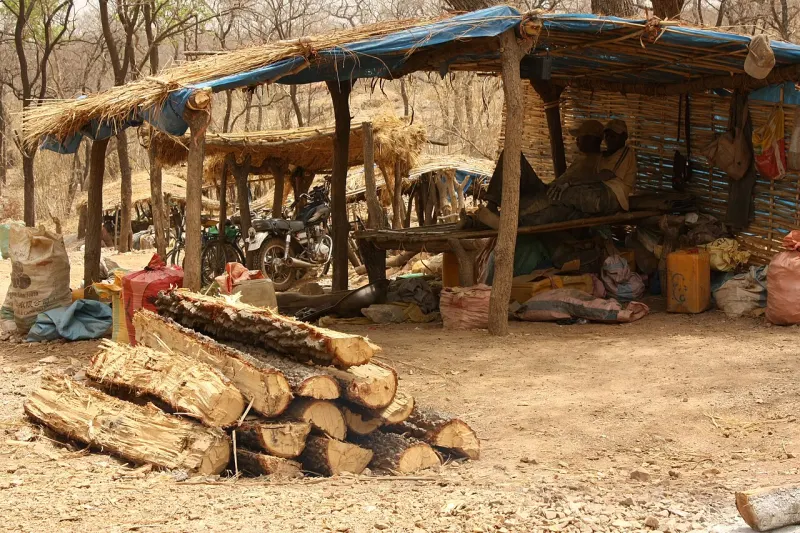
The fight against illegal gold mining in Upper Guinea has taken a deadly turn. According to a provisional toll released by the government on Thursday 12 November 2026, ten people were killed and thirteen injured in clashes the day before in the Sètiquiyah area, Balato district, in the Kintinian sub-prefecture (Siguiri prefecture).
A patrol blocked by barricades
The defence and security forces had been deployed to enforce a joint order of 2 November banning “anarchic and illegal” gold mining. According to the official statement, protesters put up barricades to prevent the operation, and shots were exchanged.
The ten dead include five foreigners whose identities have not yet been established. The injured include civilians and members of the security forces. Two pick-ups and a truck belonging to the security forces were set on fire, two crushers damaged, a drinks depot destroyed and several sheds ransacked. A military weapon and a motorbike were taken by protesters.
Prosecutors called in, appeal for calm
The government strongly condemns the violence and says it will maintain the ban on illegal gold mining throughout the country. The prosecutor general at the Kankan court of appeal and the prosecutor of the Siguiri court have been asked to establish responsibility. The authorities are asking residents to remain calm, to return the weapon and motorbike taken, and not to share unverified information. No independent account of the events has yet been published.
Sentences of two to eighteen months
On the judicial front, the first verdicts have been handed down. In a statement read on 12 November on national television, the prosecutor general at the Conakry court of appeal, Falou Doumbouya, said that more than 1,300 people had been arrested during operations in the Siguiri prefecture, including nationals of several West African countries.
On 9 November, the Supreme Court took the case away from the Siguiri court and entrusted it to the courts under the jurisdiction of the Kankan court of appeal. From 10 to 12 November, the courts of Kankan, Dixinn, Mafanco, Dubréka, Forécariah and Coyah tried the defendants. Adults found guilty received two to eighteen months in prison, sometimes with a five-to-ten-year residence ban; convicted foreigners will be expelled. The Kankan court alone ruled on 122 people of various West African nationalities.
Minors were brought before the Kankan juvenile court, which ordered protection and support measures. The proceedings before the CRIEF, targeting in particular 22 former territorial administrators of Siguiri, are continuing separately: that trial has been adjourned to 16 November.
Correction (13 November 2026): an earlier version of this article wrongly stated sentences of “up to 18 years” in prison. The sentences handed down range from two to eighteen months in prison, with a five-to-ten-year residence ban for some.
Comments
Loading comments…